Borusan Contemporary,
is a contemporary art, collection and education initiative of the Borusan Kocabıyık Foundation.
Personal Data Protection
Cookie Policy
© Borusan Contemporary, 2026.
Current Exhibitions
Haunted
19 September 2026 - 15 August 2027
COLLECTION EXHIBITION
CURATOR: DR. KUMRU EREN
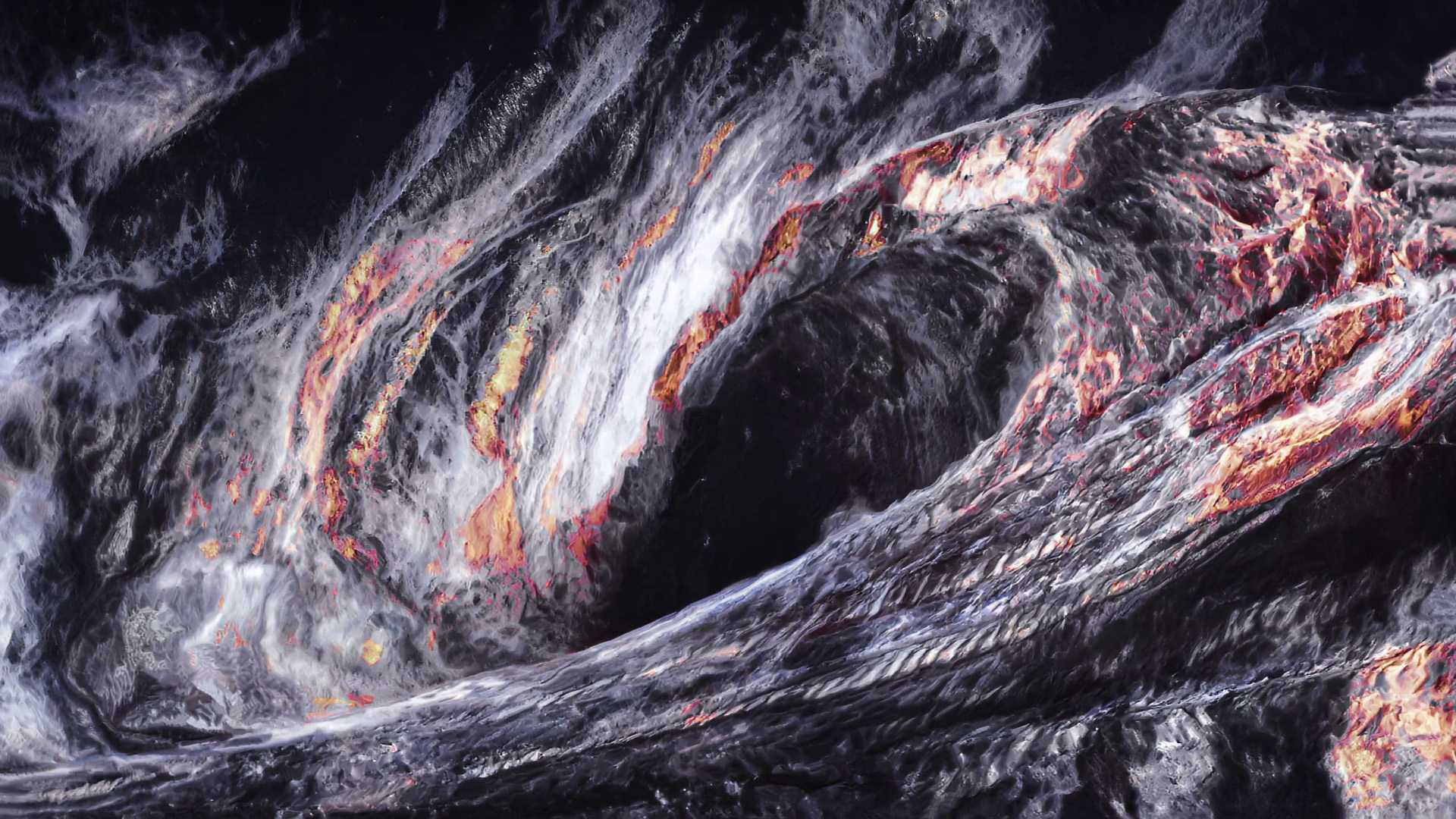
Memo Akten, Dalgalar 2.0: Toprak , 2023
Özel yazılım, yapay zekâ, makine öğrenmesi, derin öğrenme, gizil difüzyon modelleri,
8' döngü
Borusan Çağdaş Sanat Koleksiyonu
Summoning the Memories of the Future
On the road to Thebes, the Sphinx poses a riddle to Oedipus: “What is that which has one voice and yet becomes four-footed and two-footed, and three-footed?” Oedipus’s answer not only saves the city of Thebes and shapes his fate; it also points toward one of the foundational ideas of Western thought. From that moment onward, the human being occupies the center of philosophy, art, and science, becoming the measure of truth. From Ancient Greece to the present, humanity has been regarded as the subject through which the world is understood, the primary measure of being, and the privileged bearer of knowledge. Yet Oedipus’s tragedy lies not in answering the riddle, but in failing to solve the riddle of his own existence.
Today, the same ancient riddle returns. This time, however, it is posed not by the mythical creature suspended between human and animal, but by a different kind of apparition that stands between human and nonhuman: algorithms and artificial intelligence. As the Sphinx's riddle continues to resonate across the centuries, humanity, like Oedipus on the road to Thebes, advances toward its own prophecy.
What does it mean to be human in a posthuman world?
Artificial or “human-like” intelligence, the technological transformations driven by cybernetic networks and nanobiotechnologies, and “the fourth industrial revolution” have been shaping a new aesthetics for some time now; their impact is increasingly felt in the conceptual and formal dimensions of art. As software systems reshape society, artificial intelligence—with its promise of turning science fiction into science and its ever-accelerating capacity to learn—joins a trajectory that extends from kinetic art to computational image-making. Like a specter haunting the centuries-old, human-centered legacy of Western art history, it gives shape to the very fabric of posthuman aesthetics.
In Four Quartets, T.S. Eliot suggests that the past, the present, and the future reverberate within one another. Haunted moves through this layered experience of time. These are not only traces carried from the past into the present, but also echoes of unrealized possibilities, unfinished futures, and moments still waiting to be remembered. As Jacques Derrida reminds us, the ghost is never simply what returns; it is also that which has not yet arrived. Data traces, kinetic installations, and interactive systems emerge as the new unknowns haunting Perili Köşk (the Haunted Mansion), confronting viewers with a world that feels convincingly real yet incomplete, familiar yet lacking the human subject. Much like the uncanniness of an unforgettable lover, a memory that refuses to fade, or the Sphinx waiting at the gates of Thebes.
As technological imaginaries aimed at surpassing the limitations of human beings intersect with contemporary art's pursuit of abstraction beyond the object, the works selected from the Borusan Contemporary Art Collection converge within a field of tension between the uncanny and transcendence, ecstasy and experience, image and trace, absence and presence. Shaped through sound, movement, light, and data, these manifestations offer a human-centered perspective on the brief history of posthuman aesthetics while inviting viewers to reconsider perception, subjectivity, and reality.
Twenty-five centuries ago, Western thought defined the human in a riddle; the question once posed at the gates of Thebes still awaits an answer. What has changed today is not the riddle itself, but the one who asks it. In a world haunted as much by specters carried over from the past as by "that which has not yet arrived," Haunted traces the Sphinx through data flows and invisible networks. Perhaps the Sphinx never truly disappeared; it simply assumed a new form with each technological advancement. Today, for humanity, the question is not so much whether machines have begun to think, but whether the ancient riddle that once defined humanity still has a single answer.
Artists
Daniel Canogar
DRIFT
Kemal Önsoy
Marco Brambilla
Memo Akten
Quayola
Rafael Lozano-Hemmer
teamLab
Zimoun
Click for the exhibition brochure.

 Baltalimanı Hisar Cad.
Perili Köşk No:5 34470
Rumelihisarı / Sarıyer
İstanbul Türkiye
 0 (212) 393 52 00
  info[at]
borusancontemporary
[dot]com
ADMISSION
Adult: 350 TL
Discounted: 100 TL
Group: 300 TL
VISITING
HOURS
Saturdays and Sundays only
10.00—19.00
Last Entry: 18.00
Borusan Contemporary,
is a contemporary art, collection and education initiative of the Borusan Kocabıyık Foundation.
Personal Data Protection
Cookie Policy
© Borusan Contemporary, 2026.
is a contemporary art, collection and education initiative of the Borusan Kocabıyık Foundation.
Personal Data Protection
Cookie Policy
© Borusan Contemporary, 2026.
FOLLOW





BORUSAN CONTEMPORARY